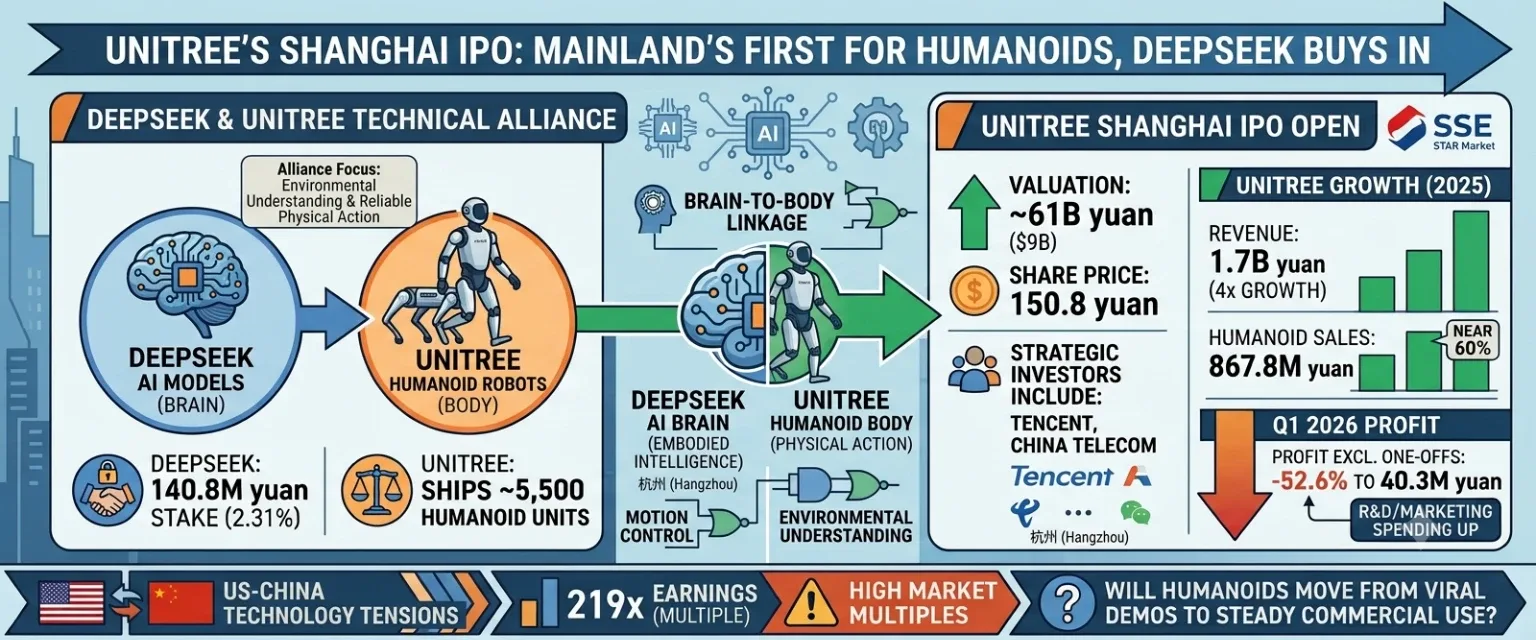
Chinese robotics firm Unitree opened public subscription for its Shanghai IPO on August 10, with AI lab DeepSeek among the strategic backers. The offering is priced at 150.8 yuan a share, valuing the humanoid-robot maker at about 61 billion yuan ($9 billion). It would be the first such company listed on mainland China's stock market.
The DeepSeek tie is the deal's most closely watched feature. A stock exchange filing released on August 6 showed the AI startup, led by founder Liang Wenfeng, put 140.8 million yuan ($19.6 million) into the strategic allotment, securing 933,399 shares, or a 2.31% stake, with a 36-month lock-up. Both companies are based in Hangzhou.
The two firms also signed a technical alliance. They plan to pair DeepSeek's AI models with Unitree's work in motion control and embodied intelligence. Unitree will give DeepSeek preference when buying model-training services; DeepSeek will favor Unitree when procuring robots. The goal is a robot "brain" that can understand new surroundings and turn instructions into reliable physical action, a bottleneck for the whole industry.
Unitree, formally Yushu Technology, is selling 40.45 million new shares, or 10% of its enlarged capital, on Shanghai's STAR Market. It aims to raise about 6.1 billion yuan ($904 million), above an earlier 4.2 billion yuan target. Payment is due by August 12, with trading expected later in the month. Other strategic investors include a Tencent vehicle, China Telecom, China National Petroleum, China Southern Power Grid and the National Council for Social Security Fund. UBTech already trades in Hong Kong, but Unitree would be the first humanoid maker on the mainland.
The company stands out for making money. Revenue more than quadrupled to 1.7 billion yuan in 2025, humanoid sales reached 867.8 million yuan and overtook its four-legged robots, and the firm shipped roughly 5,500 humanoids at a gross margin near 60%. Growth is cooling, though: first-quarter revenue rose 68.5% to 422.8 million yuan, but profit excluding one-off items fell 52.6% to 40.3 million yuan as spending on research and marketing climbed.
Beyond the numbers, the pricing is where opinion divides. The valuation works out to roughly 219 times earnings and about 36 times sales, well above listed rivals. "Unitree's IPO would serve as a valuation anchor – and effectively the ceiling – for other companies in the embodied-intelligence space," said Zheng Hualiang, founder of Hangzhou venture firm Leap VC. Retail demand is strong, yet some investors warn that robotics valuations have run ahead of what the technology can do today.
The listing also lands amid US-China friction. Washington last month introduced restrictions that could block future foreign-made humanoid and quadruped robots from US approvals, though Unitree says its existing products remain authorized. The US accounted for 13.3% of its 2025 revenue.
For readers, the number to watch is not the opening-day price but whether humanoids move from viral demos to steady commercial use. Unitree's profitability sets a bar that rivals such as AgiBot, EngineAI and Deep Robotics will now be measured against as they line up their own listings. If demand for working robots fails to materialize, today's multiples will be hard to defend – and much of the sector's value rests on software that has yet to prove itself.