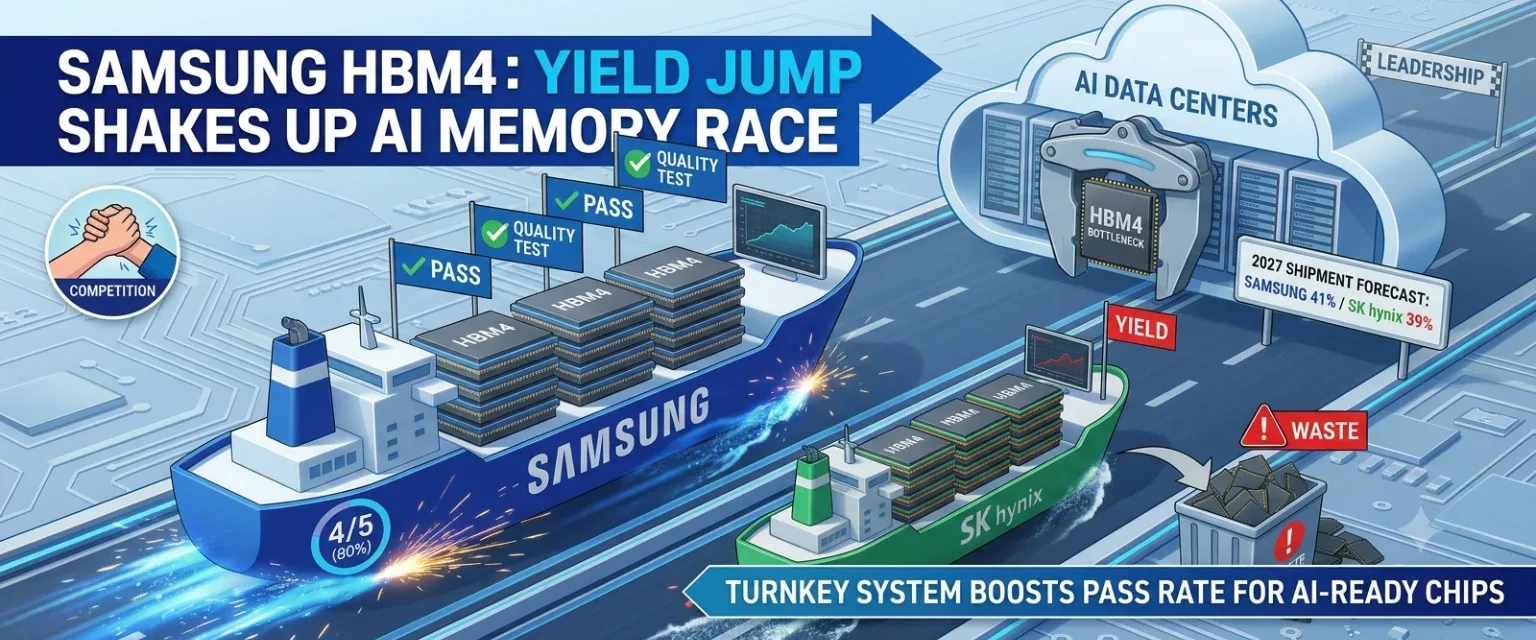
Samsung Electronics says its newest AI memory now passes quality tests about 80% of the time, a level reached just six months into mass production of its sixth-generation HBM4 chips. Analysts at the investment bank UBS say the jump could let Samsung overtake long-time leader SK hynix in shipments next year. It matters because these chips are the biggest brake on the build-out of AI data centers.
High-bandwidth memory, or HBM, sits next to the processors that train and run AI systems and feeds them data fast enough to keep up. The chips are hard to make. Samsung's pass rate, known as yield, sat below 60% when it started mass-producing HBM4 in February 2026, the first company in the world to ship the new generation. The industry treats an 80% yield as a threshold where defects fall low enough to make real money.
Samsung credits the gain to running its memory, chip-making and packaging units as one team from the design stage, an approach it calls a turnkey system. It also says it solved a stubborn heat-and-power step in the stacking process. Kim Jae-jun, an executive vice president in Samsung's memory business, told an earnings briefing that third-quarter HBM4 revenue would more than triple from the prior quarter, and that HBM4 would make up over 60% of the company's HBM sales in the second half.
That is what puts SK hynix's lead in play. UBS projects SK hynix will stay first this year with 48% of shipments, but sees Samsung edging ahead in 2027 at 41% against SK hynix's 39%. The stakes are large because supply is scarce. HBM is sold out across all makers through 2026, and Intel chief Lip-Bu Tan has named the memory shortage as the single biggest bottleneck in AI, ahead of compute and power.
SK hynix is not standing still. Industry estimates say its own HBM4 yield has also reached the 80% range, and it argues that a single yield figure misses the point. "HBM4 competitiveness is completed only when it encompasses not just simple specifications but also the ability to supply in large volumes with stable yields and quality," Kim Ki-tae, an executive vice president in charge of HBM sales at SK hynix, said on the company's second-quarter call.
Beyond the numbers, the shift is one of emphasis. The race is moving from who can invent the chip to who can churn out the most working ones at scale. Both firms are pouring money into new plants, but that capacity takes years to arrive, so the near-term winner is whoever can qualify with Nvidia and AMD and ship in volume now. Nvidia has already eased some HBM4 spec requirements, a sign of how tight things are.
For now, the memory crown is still SK hynix's, and yield reports are not the same as customer orders. The figure to watch is not the 80% headline but whether Samsung's chips pass Nvidia's tests and reach servers at volume. If they do, the company that has spent years playing catch-up in AI memory could pull level just as demand outstrips anything the industry can build.